
Infant Eye Care
Your baby’s first eye exam belongs at 6 months of age, even if no problems are apparent.
Schedule An Infant Eye Exam Appointment
─ Dr. Elizabeth Johnson, OD · St. Louis Park, MN
Eye care is part of infant wellness.
The American Optometric Association recommends scheduling your baby’s first eye assessment at 6 months. Dr. Elizabeth Johnson, OD, provides a comprehensive infant eye assessment starting at 6 months of age, in St. Louis Park.
Dr. Johnson tests for:
- Excessive or unequal amounts of nearsightedness, farsightedness or astigmatism
- Eye movement ability
- Eye health problems
These problems are not common, but it is important to identify children who have them at this young age. Vision development and eye health problems are easier to correct if treatment begins early.
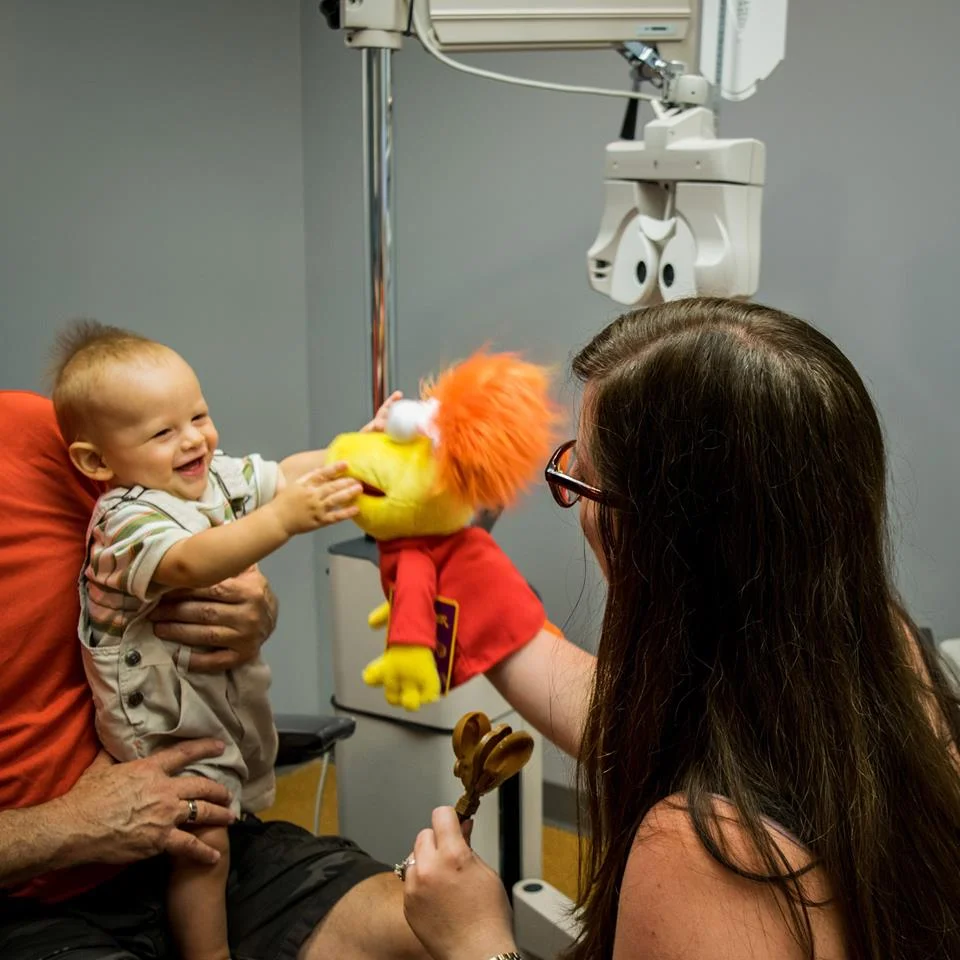
What to expect, month by month.
Prenatal care: a bright start
Proper prenatal care and nutrition are very important to the development of healthy eyes and the related nervous system.
At birth: opening to a new world
Eyes should be examined for signs of congenital eye problems. These are rare, but early diagnosis and treatment matter. Soon babies focus on objects less than a foot away, like a parent’s face.
Two months: learning to look
Eyes may not always track together for the first six to eight weeks. Moving both arms or legs at the same time helps foster bilateral and binocular development.
Four months: eyes, brains, hands
Babies begin to follow moving objects with their eyes and reach for things as eye-hand coordination and depth perception develop.
Six months: a trip to the optometrist
Time for the first comprehensive eye assessment: visual acuity, nearsightedness, farsightedness, astigmatism, eye alignment, eye teaming and eye health.
Eight to twelve months: getting mobile
Babies use both eyes together to judge distances and grasp and throw with more precision. Crawling builds eye-hand-foot-body coordination.
Simple ways to help vision develop.
Babies are drawn to complex shapes, high contrast and new objects. Choose bright, contrasting, varied décor and move things around. Babies should sleep on their backs, with supervised tummy time for visual and motor experience.
Around four months
- Use a nightlight in your baby’s room.
- Change the crib’s position often, and your baby’s position in it.
- Keep reach-and-touch toys within focus, about eight to twelve inches away.
- Talk to your baby as you walk around the room.
- Alternate right and left sides with each feeding.
- Hang a mobile above and outside the crib.
Around six months
- Let your baby explore different shapes and textures with their fingers.
- Give your baby the freedom to crawl and explore.
- Play “patty cake” and “peek-a-boo” together.
Eight to twelve months
- Give your baby stacking and take-apart toys.
- Provide objects your baby can touch, hold and manipulate.
Questions, answered.
- When should my baby have a first eye exam?
- The American Optometric Association recommends scheduling your baby’s first eye assessment at 6 months of age, even if no eye or vision problems are apparent.
- What does Dr. Johnson check during an infant eye assessment?
- Dr. Elizabeth Johnson, OD, tests for excessive or unequal amounts of nearsightedness, farsightedness or astigmatism, eye movement ability, and eye health problems.
- Why check a baby’s eyes so early?
- These problems are not common, but it is important to identify children who have them at a young age. Vision development and eye health problems are easier to correct if treatment begins early.
- Is it normal for my newborn’s eyes not to track together?
- For the first six to eight weeks of life, it is normal for a child’s eyes to not always track together. It should not be a concern unless the eyes are never aligned or their alignment does not gradually improve.
- My baby has watery eyes. Is that normal?
- Tears are normal for many babies because the tear drainage ducts may not have fully opened. They usually open on their own, but let the doctor know if it continues or seems excessive.
Questions about your baby’s eyes?
Call us at (952) 222-3578, Monday–Friday 9am–5pm, or Contact Us.
Eye care for the whole family.
Infant, pediatric and adult eye care with Dr. Elizabeth Johnson, OD, in St. Louis Park.
St. Louis Park, MN 55426
9am–5pm
─── iCare Family Vision · St. Louis Park, MN